
Credible Climate Action Starts with Evidence: Why Digital Trust Matters
Climate claims are easy to make. Proving them is another story. As companies invest in tree planting, carbon credits, and ecosystem restoration, the gap between environmental promises and verifiable evidence creates opportunities for greenwashing. The EU’s Empowering Consumers for the Green Transition Directive (2024/825), applicable since September 2026, introduces stricter rules against misleading environmental claims in consumer-facing marketing. In this new landscape, transparency is no longer optional. Reliable data, digital traceability, and independent verification are becoming essential to building trust in climate action.
Digital trust infrastructure refers to the technologies and systems that make environmental information traceable, transparent, and auditable. Whether a company funds tree planting, purchases carbon credits, or supports ecosystem restoration, stakeholders increasingly want to see the evidence behind those actions. Digital trust infrastructure makes that possible by connecting environmental claims to reliable, accessible data. At EcoMatcher, we believe transparency starts with the individual tree, supported by reliable field data and digital traceability.
The list of technologies that fall under this infrastructure is growing. It includes registries, geospatial records, monitoring platforms, timestamps, common data standards, and, in some cases, distributed ledgers. Of course, this infrastructure does not create climate impact on its own. It can make claims easier to inspect.
Verification starts with the primary data
Digital technology cannot create trust on its own. Its real value lies in showing where environmental data comes from and how it has been recorded and maintained. While technologies such as blockchain, satellite monitoring, and AI can strengthen transparency, they cannot compensate for inaccurate or incomplete source data.
The foundation of credible environmental claims is reliable information about what has actually happened. Technology helps preserve that evidence, making it possible to trace records back to their origin and understand how they have changed over time.
Can you follow it backward?
That’s a generally useful question for any environmental claim. If an organization says it supported a particular climate outcome, can you trace that statement through the project transaction or registry to the underlying evidence?
The World Bank’s Climate Action Data Trust was created partly in response to this problem. It links and harmonizes metadata from carbon registries so that market participants can compare records and identify potential double-counting risks.
The principle extends beyond carbon markets: environmental claims become more credible when the evidence has an identifiable history.
More data does not automatically mean more transparency
Making environmental data publicly available is an important first step. But data alone does not guarantee transparency, especially when information is fragmented, inconsistent, or difficult to interpret.
A 2025 World Bank report on data and systems interoperability in carbon markets warned that fragmentation between registry systems creates barriers to transparency, traceability, and market efficiency. It also noted that inconsistent data structures make it harder to aggregate and compare information.
This is why interoperability is such an important part of trust infrastructure. When two systems can’t exchange information reliably, users have to do it manually, which adds costs and increases the risk of mistakes.
Digital records and independent verification
Another important distinction is between traceability and verification. Independent verification is necessary to ensure the underlying claim is environmentally sound. It typically asks different questions:
- Was the approved methodology followed?
- Is the data plausible?
- Does the outcome meet the relevant standard?
- Are the assumptions justified?
This means that trust builds in layers. Field observations are necessary to provide evidence. The digital systems preserve and connect that evidence, while standards define the rules. Independent assurance then tests whether those rules have been met. Replacing all of this with a single technology would be fundamentally misunderstanding the problem.
That also explains why current efforts to strengthen carbon markets focus on systems rather than just individual technologies.
In 2026, the Integrity Council for the Voluntary Carbon Market (ICVCM) argued that fragmented infrastructure and inconsistent approaches continue to remain obstacles to transparency and scale. They call for greater standardization and interoperability across the market. The ICVCM’s recommendations reflect a broader shift towards treating information architecture as part of market integrity.
Trust infrastructure improves markets
Digital trust infrastructure definitely costs money, and many organizations see those costs as overhead, but lower-trust markets also carry hidden costs.
For example, when a buyer can’t compare projects confidently, they will need to do more due diligence. When data is fragmented, intermediaries have to reconcile it; when quality is unclear, buyers may discount all assets rather than distinguishing the strongest ones.
Evidence already shows that credibility affects value. The World Bank’s 2026 carbon-pricing report found that credits with high ratings or recognized integrity labels continued to command premiums. For reforestation projects, its analysis reported an 87% price increase for each improvement in rating band.
Beyond carbon markets, this transparency also helps companies demonstrate their environmental commitments, strengthen stakeholder confidence, and reduce the risks associated with unsupported sustainability claims.
EcoMatcher’s commitment to trust infrastructure
Tree planting is perhaps the most accessible illustration of digital trust infrastructure. An organization can get certificates saying that 10,000 trees were planted. However, that’s just one piece of information. It doesn’t tell the company which species were planted, where they were planted, when planting occurred, what happened afterward, or who’s looking after the trees.
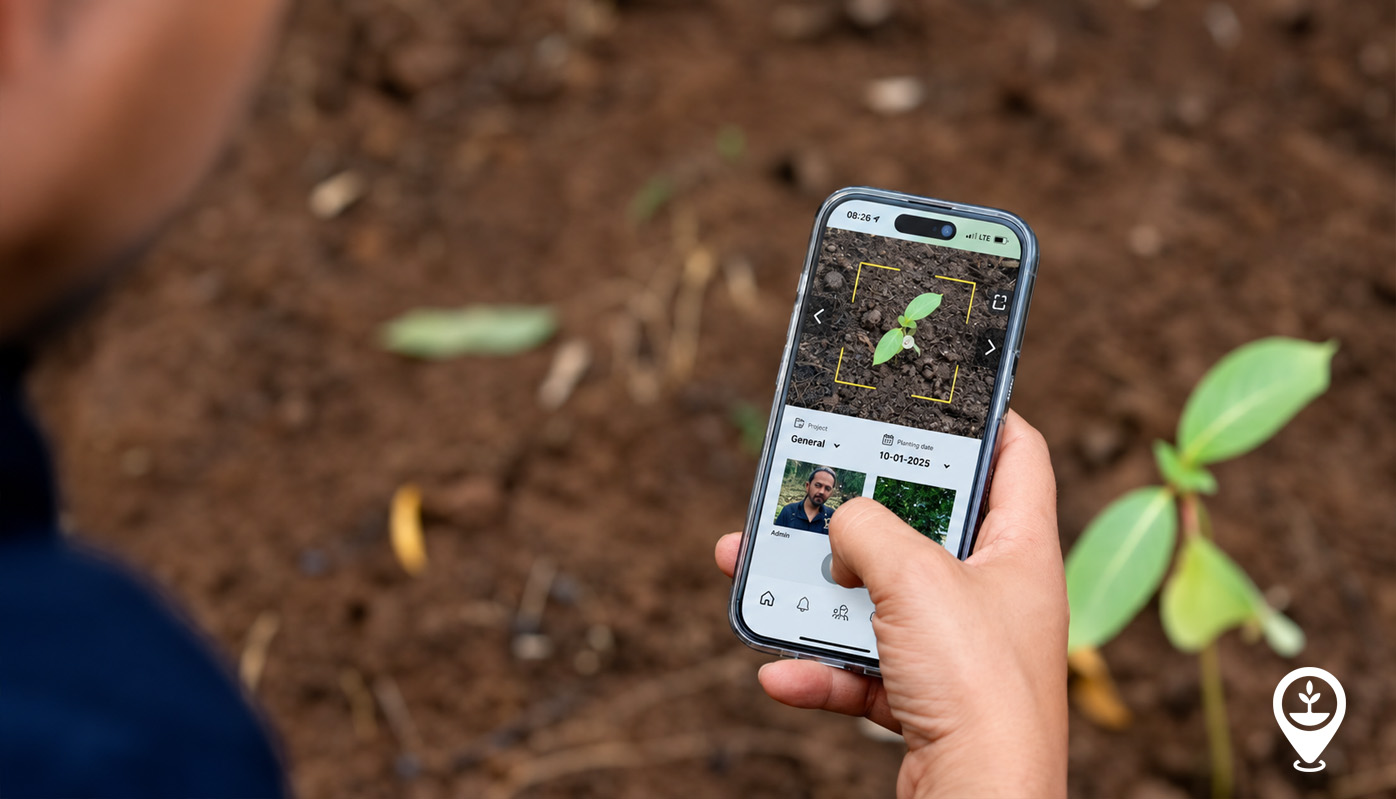
EcoMatcher addresses this by recording individual trees through its TreeCorder technology. This includes data such as location, planting date, photographs, and other unique identifiers. Our technology platform also uses TreeChain, a distributed ledger that stores tree records and transaction histories. TreeTracker makes individual trees accessible to recipients, while ForestTracker gives organizations an overview of their forests. EcoMatcher’s monitoring reports can also include information such as survival rates by species and before-and-after project imagery.
Beyond environmental credibility, this infrastructure can create business value. Companies can share traceable trees with customers, employees, and other stakeholders through gifting, engagement, loyalty programs, and rewards, turning planting initiatives into meaningful interactions.
For companies seeking certified carbon removals, EcoMatcher’s optional TREES+ offering combines tree-level transparency with carbon project development and independent verification under recognized international standards such as Verra and the Gold Standard. Digital traceability and independent certification serve complementary purposes.
The final word
We believe that digital trust infrastructure is most likely to look like a stack. Some layers will be technological: field data, remote sensing, common identifiers, APIs, etc. Other layers will still depend on institutions, governments, and human judgment. Together, they make the journey from activity to claim visible enough to question, verify, and understand.
In a climate economy increasingly shaped by environmental claims, digital trust infrastructure is no longer just an administrative requirement. It is becoming essential to the credibility and effectiveness of climate action. The future of credible climate action depends not only on what we do for the planet, but also on what we can prove.