

What is False Autumn?
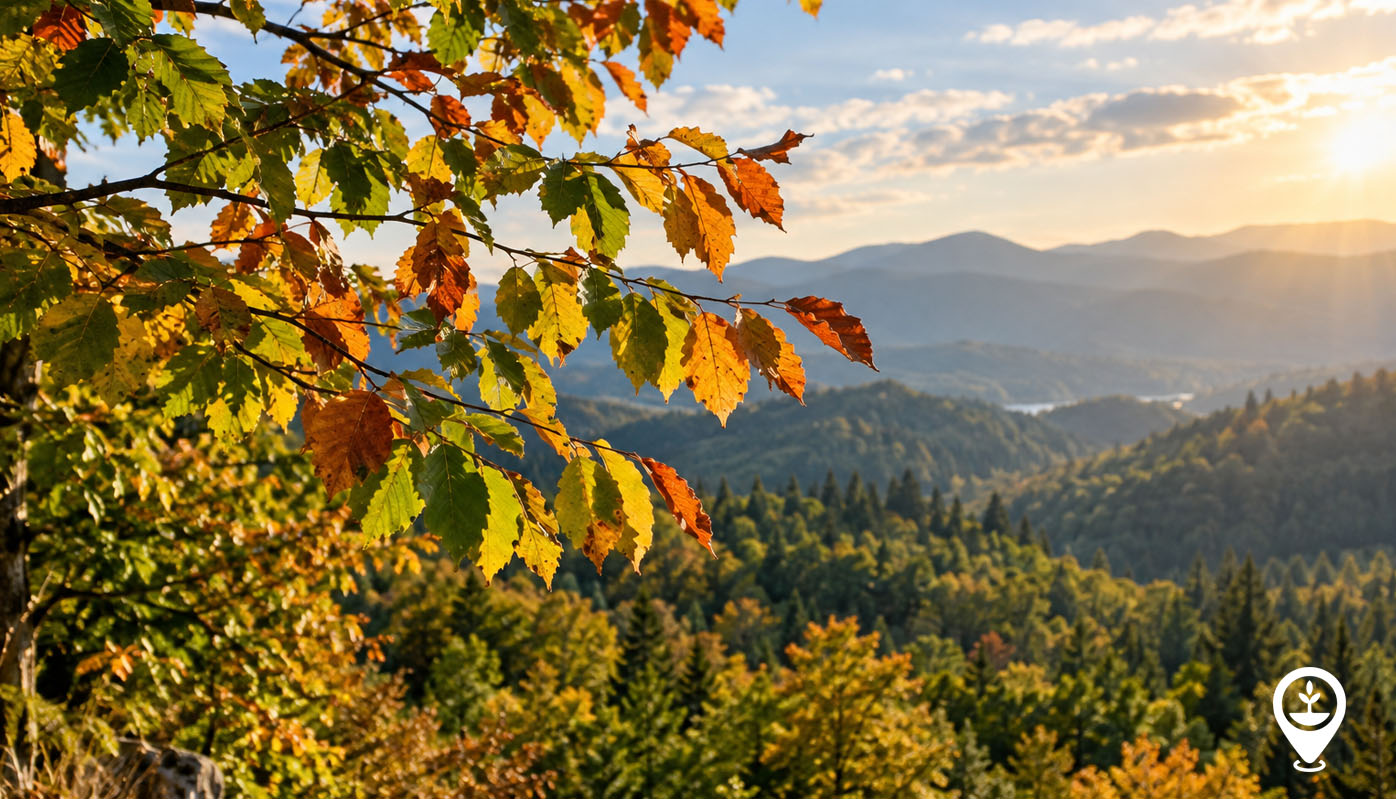
What if autumn arrives weeks before it should? In many countries, trees that should still have full green canopies are already turning yellow or brown.
This phenomenon is often called false autumn. It’s autumn-like changes that appear unusually early, especially when trees start browning or shedding leaves after intense heat and drought. For example, in 2025, the UK Met Office reported that there was widespread early leaf fall after an exceptionally warm and dry spring and summer.
But false autumn isn’t just autumn arriving ahead of schedule. In many cases, it’s also a stress response. A tree is cutting its losses because keeping a full canopy has become too expensive for it. What does the early fall of leaves tell us about how forests are responding to a changing climate?
Signals of autumn
The seasonal behaviour of trees is considered part of their phenology. This is the timing of the recurring biological events that include bud burst, flowering, fruiting, and when the leaves fall.
For deciduous trees in a temperate climate, autumn is usually a gradual and coordinated process. Changes in day length provide a reliable seasonal signal, and temperature, moisture, and other environmental conditions also affect timing.
As the season for growing ends, chlorophyll breaks down, and the trees recover some of the nutrients in their leaves before shedding them. When the green chlorophyll disappears, it reveals pigments that produce the familiar red, yellow, and orange colours of autumn.
However, climate change is also complicating this seasonal system. Nowadays, not all environmental signals are changing together. The length of the days is still controlled reliably by the Earth’s orbit, but temperature and rainfall aren’t similarly predictable.
Between 1961 and 2018, research was done using 49,088 observations of six tree species in Switzerland. The research found that leaf unfolding had advanced as much as 3 days per decade since 1985. It also found out that leaf colouring was generally becoming later at lower elevations. That said, it also found that drought stress during the growing period increased, which meant that trees were experiencing a different combination of seasonal conditions.
False autumn = stress
Leaves are important to trees because they capture sunlight and turn carbon dioxide and water into sugars through photosynthesis. But leaves also lose water through tiny pores called stomata. These stomata allow carbon dioxide into the leaf and also allows water vapour to escape through transpiration. When there’s a lot of moisture in the soil, this exchange can continue, but if there is a prolonged drought, replacing that lost water becomes increasingly difficult for the leaves.
What happens then is that trees can respond by closing their stomata, which means that it limits water loss but also restricts photosynthesis. When there is sufficiently severe stress, shedding leaves reduces the surface area from which water can escape, which makes it an emergency water conservation measure.
Research published in Nature Climate Change drew on ground observations dating from the 1940s alongside 34 years of satellite data. In that research, it was found that drought had become increasingly important in determining the timing of autumn leaf senescence across the Northern Hemisphere. Warmer temperatures could delay that senescence, but associated water shortages would then push it in the opposite direction.
Dropping leaves for survival, with a cost
Premature leaf loss does not directly mean that a tree is completely dying. Mature trees with large root systems are often able to withstand severe dry periods and go back to normal growth in the coming year. Early shedding can itself be part of the mechanism that allows them to survive; however, there’s a trade-off.
Since leaves are a tree’s main photosynthetic machinery, losing them weeks earlier than expected shortens the period in which the tree captures carbon and manufactures carbohydrates. The carbs fuel visible growth, but they’re also allocated to systems like roots, maintenance, defence, and reserves to be drawn on later.
Research published in 2026 illustrates how dramatic the shift can become during extreme conditions. Researchers studied deciduous forests after Europe’s exceptional heat and drought in 2022. They found that crown discoloration was occurring around 40 days earlier than the normal time period at low-elevation sites and around 15 days earlier at alpine and pre-alpine sites. In the high-elevation site, they also found reduced biomass production in the following year.
A general scrambling of seasonal signals
False autumn illustrates how complex the effects of climate change on forests can be. Warming causes leaves to emerge earlier in spring, and mild autumn temperatures may allow them to remain active later, which, in theory, can lengthen the growing season.
However, hotter conditions can also increase the atmospheric demand for water, and if soil moisture cannot keep up, trees can encounter drought earlier or more intensely.
A 2026 experiment on four temperate tree species found that warming combined with changes in drought timing could leave seedlings particularly vulnerable. Earlier phenological development under warmer conditions can expose young trees to water shortages during sensitive stages of growth.
These responses often differ substantially between species, places, and individual trees. A lot of factors matter, including soil depth, elevation, root systems, previous stress, and local microclimate. That means that a brown canopy that is unusual doesn’t automatically mean climate change. It could also be because of pest outbreaks, disease, storm damage, soil compaction, or other pressures.
A stronger conclusion would be that the hotter, drier extremes increase the conditions in which stress-induced leaf fall becomes more likely.
What false autumn means for forest restoration
We can learn from false autumn that successful restoration can’t be measured only by how many trees go into the ground. A planted tree still has to survive decades of changing weather. Restoration planning therefore needs to consider soil, water availability, species diversity, local ecology, and the climatic conditions trees may face throughout their lives.
It’s important to choose the appropriate species for the location that’s being reforested. But it’s also equally important to choose the right ecosystem. Restoration may involve natural regeneration, agroforestry or the recovery of non-forest ecosystems rather than planting trees everywhere. As we’ve previously written, sometimes “more trees” isn’t the answer.
Monitoring is also extremely critical. A project that records trees that have been planted but doesn’t examine establishment, survival, or changing environmental conditions captures only the first stage of restoration. False autumn usually makes that point visible. A tree may be standing and alive while still experiencing considerable climatic stress. This is why long-term field monitoring matters alongside tree-level traceability, such as the planting location, date, and species information recorded through EcoMatcher TreeTech.
The final word
Climate change won’t move every forest neatly onto a new seasonal timetable. Instead, it’s altering several forces that control tree growth at once, sometimes in competing directions. What that means is that false autumn is also an example of forests having to operate under conditions where their familiar seasonal rhythms no longer serve as a reliable guide. For successful forest restoration, planting trees is only the beginning. Helping them survive and thrive is what ultimately matters.