

What El Niño 2026 Means for Forests
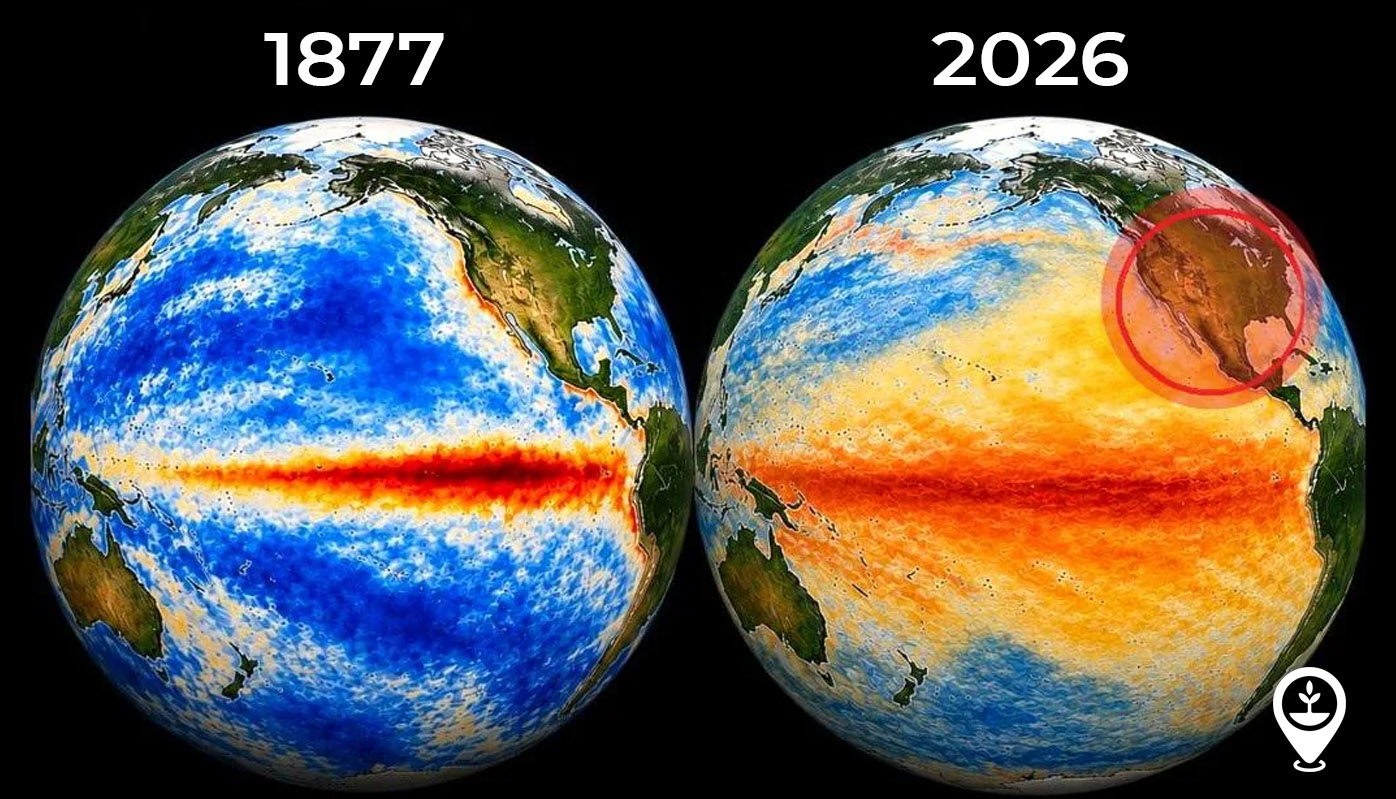
Every few years, a shift in Pacific Ocean temperatures sets off a chain of climate effects that ripples across every continent. This recurring phenomenon is called El Niño, and it’s forecast to return in 2026. Understanding what it typically brings is useful for anyone involved in reforestation and forest restoration work.
According to NOAA’s Climate Prediction Center, there is an 82% chance of El Niño emerging by mid 2026, with a 96% chance it persists through winter 2026–27. The World Meteorological Organization (WMO) notes that climate models are now “strongly aligned” on this outcome, though the eventual strength of the event remains uncertain.
What Is El Niño?
El Niño is a periodic warming of surface waters in the central and eastern tropical Pacific Ocean. It occurs every two to seven years and influences climate patterns around the world, with effects that vary considerably by region, timing, and intensity.
The name comes from Peruvian fishermen, who centuries ago noticed that every few years, around December, the normally cold and fish-rich waters off their coast would warm. Their nets would come up empty, and the fish had gone. Because this strange warming tended to arrive around Christmas, they named it El Niño, which is Spanish for “the Christ child.” The first written reference describing its effects in Peru dates to a letter from 1891, though the phenomenon itself had been observed for generations before then.
For a long time, El Niño was thought to be a local quirk of the South American coast. It was only in the 1960s that a meteorologist named Jacob Bjerknes, using early satellite data, realized the warming was not confined to Peru. It extended thousands of miles across the Pacific and was connected to a global pattern of atmospheric pressure changes. That breakthrough transformed El Niño from a regional curiosity into one of the most studied climate phenomena on Earth.
So what is actually happening? Under normal conditions, strong trade winds blow westward across the tropical Pacific, pushing warm surface water towards Indonesia and Australia, and allowing cool, deep water to well up along the South American coast. El Niño occurs when those trade winds weaken, sometimes reversing entirely. Without the winds pushing it west, warm water spreads back eastward across the Pacific. That single shift—a pool of unusually warm ocean water sitting in the wrong place—is enough to disrupt atmospheric circulation patterns across the entire planet. More warm water means more evaporation, more cloud formation, and more rain in some places; but it also disrupts the atmospheric pathways that normally deliver rainfall elsewhere, leaving other regions dry.
In general terms, El Niño tends to bring reduced rainfall to Australia, Indonesia and parts of Southeast Asia, while weakening the monsoon in South Asia. The Amazon basin typically experiences drier-than-average conditions. Parts of East Africa and the Horn of Africa, by contrast, often see above-average rainfall. According to the WMO, the coming months are forecast to see “nearly global dominance of above-normal land surface temperatures,” with particularly strong signals over Central America, the Caribbean, Europe, and North Africa.
What happens to forests during El Niño?
One of the more well-documented effects of El Niño on forests is an elevated risk of fire in drought-affected regions. During the 2015–16 El Niño event, fire-related forest loss in the tropical rainforests of Latin America and Asia increased tenfold compared to non-El Niño years. That was an unusually strong event, and not every El Niño produces outcomes of that scale. However, the pattern is consistent.
Drought also affects trees more gradually. Reduced moisture stunts growth and increases vulnerability to insect infestations and disease, with younger trees at greater risk than established ones. Research published in the Proceedings of the National Academy of Sciences found that in parts of the Brazilian Amazon, plant mortality rates remained elevated above baseline levels for more than three years following El Niño-related drought, reflecting the longer-term nature of these impacts.
For reforestation projects, seedlings are the most vulnerable. Studies in Panama’s tropical forests found that seedling mortality rose during El Niño-induced droughts, with effects most pronounced in forests that had already experienced human disturbance.
Where will the effects be felt in 2026?
Current forecasts suggest a varied picture across the globe.
A weakened monsoon is possible across parts of India, potentially reducing soil moisture in forested regions. Indonesia, Malaysia, and the Philippines may see drier conditions, with elevated fire risk in peatland areas. South Asia has been advised by the South Asian Climate Outlook Forum to prepare for below-average monsoon rainfall.
Brazilian forecasters have indicated that drought conditions in the Amazon in 2026 could approach or exceed the severity seen during the 2015 El Niño. The region’s forests, already under pressure from deforestation, serve as a significant global carbon store, making conditions there worth monitoring closely.
In East and Central Africa, the picture is more variable. Parts of the Horn of Africa typically experience increased rainfall during El Niño, which can bring its own challenges, including flooding. Other parts of central Africa may experience drier spells. Planting programs in the region should consult localized forecasts.
In Australia and the Pacific, El Niño years are historically associated with reduced rainfall and elevated fire risk. Pacific Island communities, many of which depend on forest ecosystems for food security and freshwater, may also face significant climate stress.
What does this mean for tree-planting work?
Millions of people across the world support or fund reforestation: whether through corporate sustainability programs, personal donations, or partnerships with environmental organizations like EcoMatcher. For them and everyone else, it’s worth understanding how El Niño years affect work on the ground.
Survival rates for newly planted trees can be lower during drought years, particularly in the most affected regions. This is a normal part of operating in variable climates, not a sign that the work is failing. Responsible reforestation programs account for this through species selection (favoring locally adapted, drought-resilient trees), careful planting timing, and monitoring. Some replanting in harder-hit areas is often needed in the following season.
The broader point is that climate variability is an inherent feature of long-term forest restoration. El Niño is part of that variability. The response from well-run programs is adaptation: adjusting what is planted, when, and where.
The final word
El Niño is a natural part of the Earth’s climate system, and forests have adapted to its cycles over a very long time. The concern among climate scientists is that rising global temperatures are shifting the baseline against which these events play out. This might actually make El Niño events more frequent and intense, stacking their effects on top of ecosystems already under pressure from deforestation and land-use change.
For those thinking about where their environmental support has the most lasting impact, this context matters. Tree planting and forest restoration are most valuable when approached with long-term commitment, sustained through both good years and hard ones.