

Green Gentrification: The Social Challenge of Sustainability
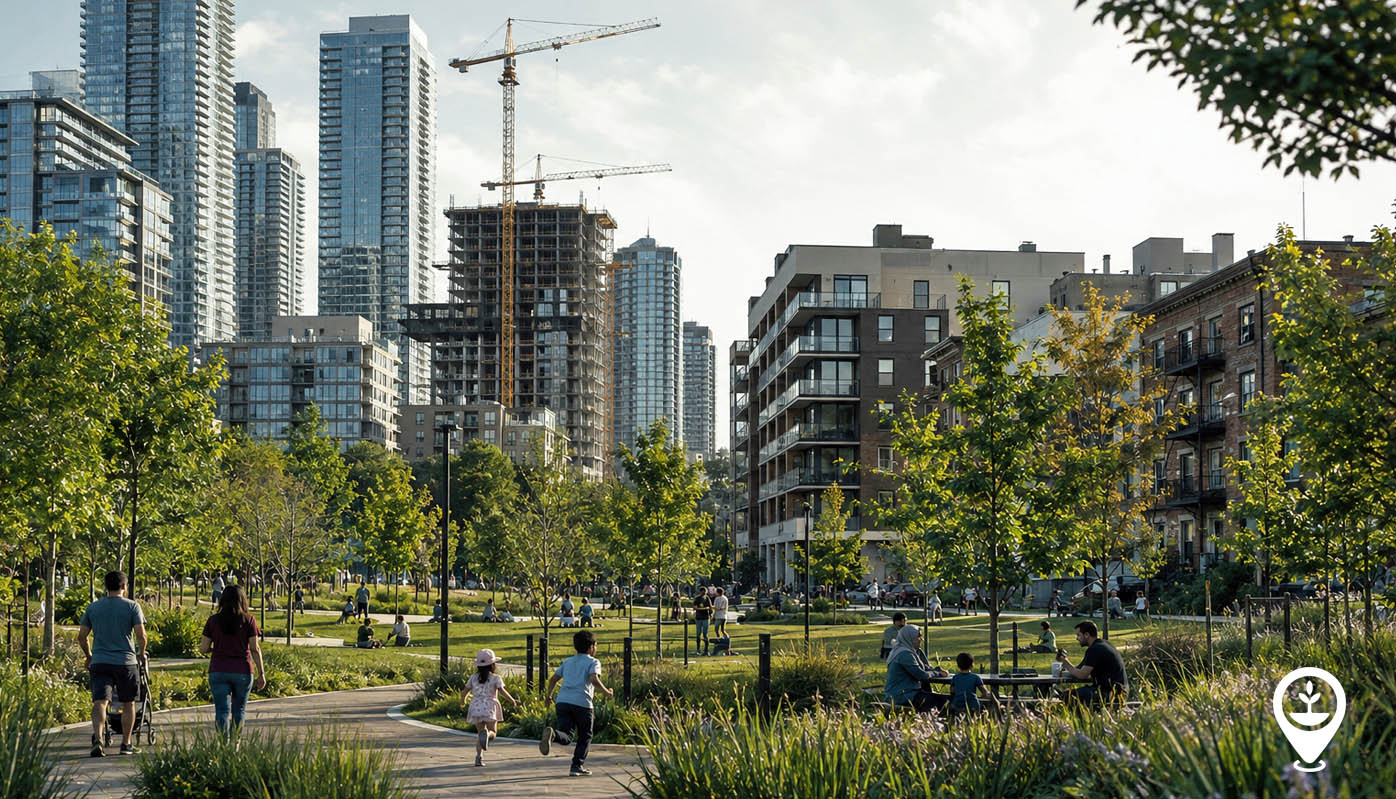
Many urban sustainability projects are designed to improve life: public parks, restored waterfronts, protected cycling routes, cleaner transport and other forms of green infrastructure. They can reduce heat, improve air quality, support biodiversity and give people better access to nature. Yet these same improvements can also make neighborhoods more desirable and expensive, placing existing residents under pressure.
This tension is known as green gentrification. From North America and Europe to cities across Asia, Africa and Latin America, research increasingly shows that environmental progress can coincide with social exclusion. It raises a question that planners, policymakers, environmental organizations and sustainability-focused businesses cannot afford to overlook: who is sustainability ultimately for?
What is green gentrification?
Green gentrification occurs when environmental improvements contribute to rising property values, rents and living costs, eventually displacing or excluding lower-income residents. It extends the familiar pattern of gentrification into the environmental sphere: the catalyst is not necessarily luxury development, but a new park, cleaner river, restored wetland or climate-resilient neighborhood.
What makes the problem especially difficult is that the improvement itself is genuinely valuable. Communities that have endured polluted air, inadequate public space or years of underinvestment often need environmental investment most. However, if housing protections do not develop alongside the green project, those communities may be unable to remain and benefit from it.
Scholars sometimes describe this as the “green space paradox”: improving access to nature can unintentionally increase housing pressure and reduce access for the very residents the project was intended to serve.
The amenity trap
The basic mechanism is straightforward. A city invests in an environmental amenity. The surrounding area becomes healthier, safer or more attractive. Developers and higher-income residents take greater interest, property values rise and landlords gain opportunities to increase rents or redevelop buildings.
New York City’s High Line is frequently discussed in green-gentrification research. The transformation of an abandoned elevated railway into a celebrated public park created a valuable urban space and became an international design model. It also accelerated investment and high-end development in the surrounding area, demonstrating how public environmental value can be captured by nearby private property markets.
This does not mean parks or green corridors cause displacement in every case. Housing markets, planning rules, land ownership, income trends and existing development pressures all matter. Green infrastructure can be one factor among many. But when it arrives in a neighborhood with insecure tenancies, limited affordable housing and speculative demand, it can become a powerful accelerator.
The residents who lived through years of disinvestment may then face a bitter outcome: they finally receive cleaner streets and better public space, but cannot afford to stay long enough to enjoy them.
Who bears the cost?
The risks are not evenly distributed. Lower-income renters, informal-settlement residents and socially marginalized communities are generally less protected from rising rents, redevelopment and eviction. These may also be the communities that have experienced the greatest environmental burdens, including pollution, heat exposure, flooding and limited access to green space.
More than 1.1 billion people worldwide live in slums or informal settlements, often with limited security of tenure. Many such communities occupy riverbanks, coastlines, steep slopes or other areas increasingly targeted for climate adaptation, flood protection, restoration or redevelopment. These interventions may be necessary, but without consultation, legal safeguards and suitable alternatives, they can turn environmental risk reduction into displacement.
The consequences go beyond the loss of a home. Displacement can separate people from employment, schools, family, healthcare, religious institutions, small businesses and mutual-support networks. Those connections often represent forms of social and economic security that cannot simply be replaced by relocating someone to less expensive housing on the urban periphery.
Research on eviction among low-income urban mothers has associated displacement with greater material hardship, depression, parenting stress and poorer reported health. Some of these effects remained evident two years later. The irony is clear: people may lose access to the healthier environment that helped increase the value of their neighborhood.
Beyond cities
A related tension can arise in conservation and restoration projects outside cities. Protected areas, national parks, wildlife corridors and rewilding initiatives have sometimes restricted access to land or displaced Indigenous peoples and rural communities. This approach is often referred to as “fortress conservation”: nature is protected by separating it from the people who have historically lived with and managed it.
International conservation standards have increasingly moved toward rights-based approaches. These recognize the importance of community participation, traditional territories, equitable governance and free, prior and informed consent. Environmental protection is more legitimate and often more durable when local people are treated as rights holders and partners rather than as obstacles.
Building social guardrails into green investment
The lesson is not that cities should stop creating parks or that governments should avoid restoration. The lesson is that environmental investment requires social safeguards from the beginning, not after displacement has already started.
Depending on the local context, these safeguards can include rent stabilization, stronger tenant rights, affordable-housing requirements, community land trusts, cooperative ownership, property-tax protections for vulnerable homeowners and guarantees that public land remains publicly accessible. Residents should participate before plans are finalized, with meaningful influence over the design, benefits and trade-offs.
International human-rights guidance emphasizes that displacement should be a last resort. Where relocation is unavoidable, affected residents should be properly consulted, given adequate notice and offered suitable compensation or alternative housing.
Green finance also has a role. Environmental projects are often assessed through measures such as hectares restored, emissions avoided or green space added. Social indicators should carry comparable weight: who benefits, who remains, whose livelihoods are affected and whether local communities share in the value created.
Policy responses remain uneven
Vienna shows how long-term housing policy can reduce displacement pressure. The city has approximately 220,000 municipal apartments and around 200,000 cooperative homes built with public support. About half of Vienna’s residents live in subsidized accommodation. Because a large share of housing is insulated from purely speculative markets, neighborhood improvements do not automatically translate into unaffordable rent increases for everyone living nearby.
Few cities can reproduce Vienna’s model quickly. However, its central lesson is widely applicable: housing policy and environmental policy cannot be treated as separate domains. A city cannot make a neighborhood sustainable if its greening strategy undermines residents’ ability to remain there.
What this means for nature-based projects
The principle also applies to tree planting, ecosystem restoration and nature-based carbon projects. Success cannot be measured only in trees planted, hectares restored or tonnes of carbon removed. Land rights, local consent, livelihoods, benefit sharing and long-term stewardship are equally important.
For EcoMatcher, this reinforces the value of working through trusted local planting organizations and making the people behind restoration visible. Transparency should extend beyond the location and species of a tree. It should also help people understand who plants and cares for it, how communities participate and how environmental investment supports lasting local benefits.
The strongest projects are not imposed on communities. They are built with them. Local knowledge improves project design, while local ownership and economic participation strengthen the likelihood that restored landscapes will be protected over time.
A different measure of sustainability
The Brundtland Commission’s influential definition of sustainable development focused on meeting present needs without reducing future generations’ ability to meet theirs. That principle is social as well as environmental.
Genuine sustainability therefore demands a broader accounting. It means measuring not only carbon, biodiversity and green space, but also security, participation and fairness. It means asking whether people can remain close to the improvements their communities helped make possible. It means recognizing that a city has not solved an environmental problem if it simply relocates social hardship elsewhere.
The green transition is urgent, but urgency should not become an excuse to overlook rights and livelihoods. For cities, companies and climate platforms, community benefit should be a core measure of success rather than a reputational addition.
A greener world that excludes the people most affected by environmental harm is not truly sustainable. The transition will be strongest when ecological progress and social equity grow together.