

The History of the Christmas Tree
The Christmas tree is one of the most recognisable symbols of the holiday season. This tradition has a complex history spanning centuries, involving ancient beliefs, medieval theatre, royal influence, and modern commercial development.
Understanding the Christmas tree’s evolution from religious symbol to agricultural industry provides useful context for current discussions about sustainable forestry and environmental impact.
The origin story
Evergreen trees held great significance for communities across Northern Europe even before the Christian era. When deciduous trees lost their leaves in winter, evergreens maintained their foliage. Ancient Romans, Celts, and Norse peoples incorporated evergreen boughs into their winter solstice celebrations, viewing these trees as symbols of ongoing life during the winter months.
From stage to home in medieval Germany
The recognisable Christmas tree we know today, however, began taking shape in medieval Germany.
During the Middle Ages, churches staged mystery plays to teach biblical stories to largely illiterate congregations. On December 24th—the feast day of Adam and Eve—these plays depicted the Garden of Eden using a “paradise tree”: an evergreen decorated with apples representing the forbidden fruit and wafers symbolising redemption.
These paradise trees initially appeared in town squares and in front of churches, serving both theatrical and theological purposes. By the late 1400s and early 1500s, however, something shifted.
Guilds began hosting Christmas celebrations indoors, bringing the paradise trees with them. A late 1500s chronicle describes a small tree in a guild house adorned with apples, nuts, dates, pretzels, and paper flowers for the benefit of members’ children. The tradition was migrating from public spectacle to private celebration, from church square to family home.
The connection of Martin Luther, a German priest and theologian, to the Christmas tree tradition is documented in later accounts, though the historical accuracy is debated. According to these stories, Luther brought a tree indoors and decorated it with candles in the 16th century, inspired by the sight of stars twinkling through the branches of evergreens.
Whether historically accurate or not, these accounts reflect the Protestant movement’s emphasis on domestic religious practice, contributing to the shift of Christmas celebrations from public church ceremonies to private family observances.
The tree goes global
German nobility embraced the Christmas tree tradition, but it remained confined mainly to German-speaking regions until the 18th and 19th centuries. Queen Charlotte, the German-born wife of England’s King George III, hosted a party at Windsor in 1800 featuring a decorated tree. However, it was Queen Victoria and Prince Albert who truly popularized the custom beyond Germany.
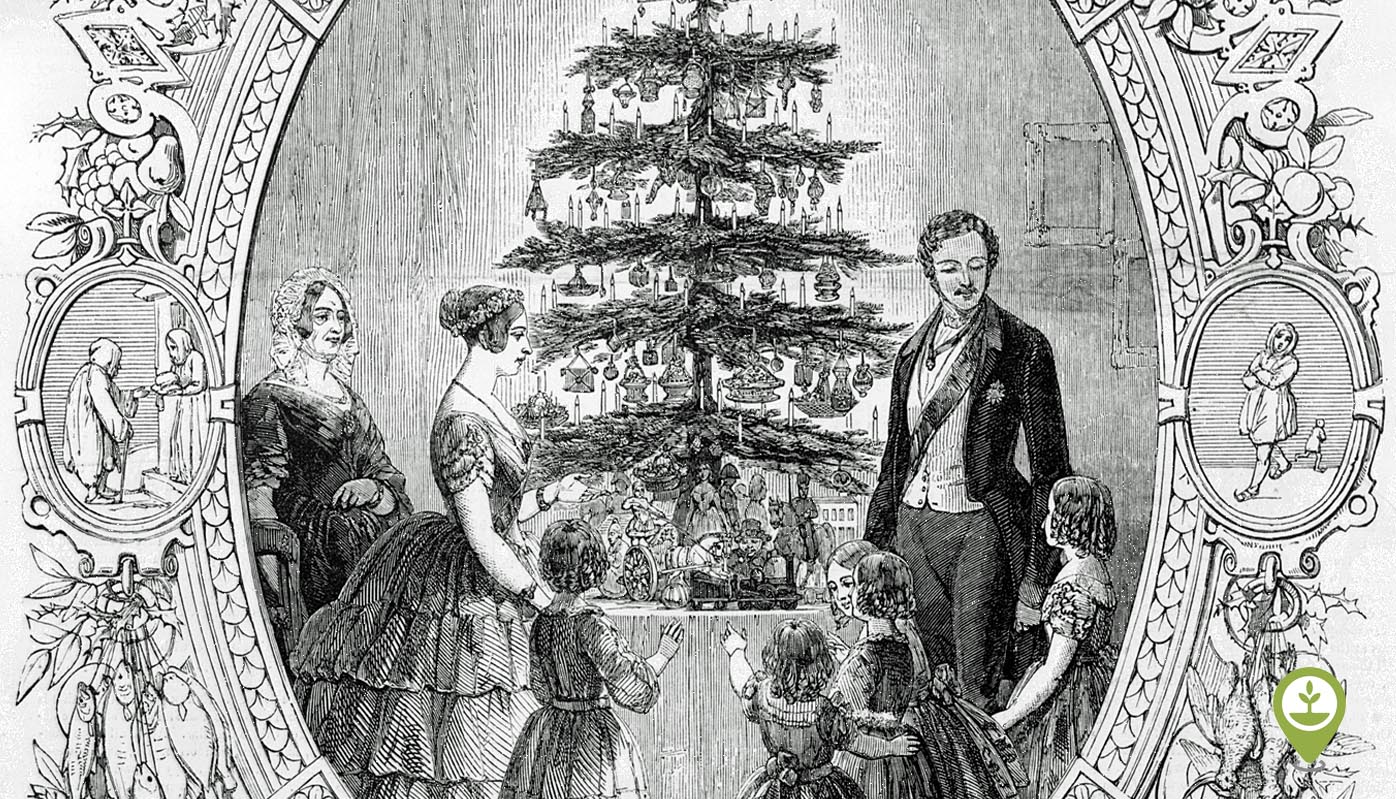
In 1848, The Illustrated London News published a now-famous image (see above) of the royal family gathered around their decorated Christmas tree at Windsor Castle. This single illustration transformed public perception about the Christmas tree.
When American publications reprinted it, they diplomatically removed Victoria’s crown and Albert’s mustache to make it appear more relatable. The Christmas tree became aspirational for middle-class families on both sides of the Atlantic.
The American Christmas tree
German immigrants had been bringing Christmas tree traditions to America since the 1700s, particularly in Pennsylvania.
Yet the custom faced resistance from Puritan-influenced communities that viewed Christmas celebrations with suspicion.
The tide turned mid-century, aided by the royal family’s endorsement and increasing German immigration. By the 1870s, Christmas trees had become commonplace in American homes, and in 1889, President Benjamin Harrison and his wife displayed the first Christmas tree in the White House.
From forest to farm: The modern industry
Today’s Christmas tree market represents a significant agricultural industry. Approximately 25-30 million real Christmas trees are sold annually in the United States alone, and the market continues growing. According to recent data, over 15,000 Christmas tree farms operate across the country, spanning operations from 2 to 9,000 acres.
Beyond the United States, Christmas tree cultivation is substantial in other regions. Germany, where the tradition originated, produces approximately 28 million trees annually. Canada is home to around 1,364 Christmas tree producers with over 50,000 acres under cultivation, with 98% of Canadian Christmas trees being farm-grown rather than wild-harvested. European countries collectively purchase 50-60 million trees each year, with Denmark being a major exporter to European markets.
What began as harvesting wild evergreens has evolved into specialised farming. Far from depleting forests, Christmas tree cultivation has become an organised agricultural practice. The National Christmas Tree Association reports that for every tree harvested, farmers plant one to three seedlings in its place. These farms create wildlife habitat, maintain soil health, and prevent land from being converted to development.
The impact on the environment
The mid-20th century saw the introduction and gradual adoption of artificial Christmas trees. These trees, initially made from materials like goose feathers in the 1880s and later from brush bristles in the 1930s, evolved into plastic versions by the 1950s.
Today, artificial trees dominate many markets. In the United States, approximately 47% of households display artificial trees, compared with 24% that use real trees. The appeal lies in convenience, reusability, and the lack of needle cleanup. That said, this shift has made people examine the comparative environmental impacts of real and artificial trees.
Research on carbon footprint shows measurable differences between options. A two-meter artificial tree, for example, generates approximately 40 kilograms of CO2. A similar-sized real tree, recycled or composted, produces 3.5 kilograms.
Christmas tree farms also sequester approximately one ton of carbon per acre during tree growth. Because farmers replant continuously, these operations maintain ongoing carbon absorption. Research indicates that supporting forest products, including Christmas trees, provides private landowners with an economic incentive to maintain forested land rather than converting it to other uses.
Re-use also affects these calculations. An artificial tree would need to be used for at least 10-12 years to have a comparable environmental profile to purchasing real trees annually. Most artificial trees are manufactured overseas, primarily in China, and are not recyclable. They typically end up in landfills, where they do not biodegrade.
Real Christmas trees, on the other hand, are biodegradable and have multiple disposal pathways. Used trees are converted into mulch, erosion-control materials, wildlife habitats, and other applications. This represents a closed-loop system where trees are grown, harvested, used, and returned to productive use.
However, the environmental comparison between real and artificial trees is relevant mainly only to regions where evergreen trees grow naturally. Christmas is celebrated in tropical and subtropical regions across Latin America, Africa, Asia, and Oceania, where evergreen conifers are not native. In countries such as Brazil, Nigeria, the Philippines, India, Australia, and throughout the Caribbean and Southeast Asia, importing real trees would involve significant transportation emissions and costs, making them environmentally and economically impractical.
For these regions, artificial trees, locally-made alternative trees using native materials, or non-tree decorations represent the accessible options.
The final word
What began as apples hanging from paradise trees in town squares has transformed into an industry worth billions, a symbol recognized worldwide, and an ongoing environmental debate.
Perhaps the most interesting aspect of this history is what it teaches about sustainability itself: there are no one-size-fits-all answers. In some contexts, seasonal tree farming protects forested land from development and maintains ecological functions. In others, it makes no sense at all. The key isn’t prescribing a single “sustainable” choice, but understanding how local ecosystems, infrastructure, and practices shape which options actually and realistically reduce environmental impact.
The evergreen’s persistence through winter still resonates across cultures, even when the tree itself is made of plastic, fashioned from palm fronds, or exists only as a projection on a wall. The symbol has outlived its original context, and that adaptability may be the most traditional thing about it!